
Pests can become a serious household problem when their presence is repeated, difficult to control, or associated with damage and hygiene concerns. Ants, cockroaches, rodents, termites, mosquitoes, and bed bugs are examples of pests that may enter or establish themselves around residential buildings. Although each pest has different characteristics, effective pest control generally follows the same basic principle: identify the problem, understand what is causing it, and apply an appropriate control method. Simply removing visible pests may provide temporary results, but it does not always address the conditions that allow them to return.
For homeowners, understanding how pest control works is useful because it helps them make better decisions when dealing with pest problems. Pest control is not necessarily about applying chemicals throughout the entire house. A more effective approach usually combines inspection, prevention, environmental management, physical control, and targeted treatment. This method can reduce unnecessary chemical use while addressing the source of the problem.
What Is Pest Control?
Pest control refers to the process of managing organisms that create unwanted effects for people, buildings, food, or the surrounding environment. In residential settings, the objective is generally to reduce or eliminate pest activity in areas where the pests are causing a specific problem.
The term “control” is important because complete elimination is not always realistic or necessary. Many insects and other organisms are naturally present in the environment. The practical objective is to prevent unwanted species from reaching levels that create health, structural, or comfort-related concerns.
For example, finding one ant in a house does not necessarily mean that professional pest control is required. However, repeatedly finding ants throughout the kitchen may indicate that there is an accessible food source or nesting site that should be investigated.
The Importance of Pest Inspection
Inspection is one of the most important steps in pest control. Before deciding how to treat a pest problem, it is necessary to understand where the pests are coming from, where they are hiding, and what conditions are supporting their activity.
During an inspection, several factors may be considered. These can include food sources, moisture, structural openings, waste, vegetation, storage conditions, and signs of pest activity. The location and frequency of sightings can also provide useful information.
A proper inspection prevents homeowners from treating only the visible symptoms. If cockroaches repeatedly appear around a kitchen sink, for example, spraying the insects may provide short-term results, but a leaking pipe or food residue may continue to support the problem.
Identifying the Pest
Correct identification is another important part of pest control. Different pests require different management strategies, and an incorrect identification can lead to ineffective treatment.
Ants, termites, cockroaches, bed bugs, fleas, and other insects may look similar to an inexperienced observer, particularly when only a small part of the insect is visible. Their behavior and preferred environments can also differ significantly.
Identification should therefore consider both physical characteristics and environmental evidence. Where the pest is found, when it appears, and what signs it leaves behind can all contribute to a more accurate assessment.
Understanding Why Pests Are Present
Pests usually do not appear randomly. They are often responding to environmental conditions that provide food, water, shelter, or access.
Food can come from exposed ingredients, food waste, pet food, crumbs, or organic materials. Water may come from leaks, standing water, damp areas, or poorly drained spaces. Shelter can be provided by clutter, cracks, vegetation, cardboard, furniture, and other undisturbed materials.
Access is another important factor. Small cracks, damaged screens, gaps around doors, ventilation openings, and spaces around pipes can allow pests to enter buildings.
Understanding these conditions makes pest control more effective because it allows homeowners to remove the reasons that pests remain in the area.
Prevention as the First Line of Control
Preventive measures are often simpler and less expensive than dealing with an established infestation. Food should be stored appropriately, garbage should be managed regularly, and moisture problems should be repaired.
Structural maintenance is equally important. Doors and windows should close properly, damaged screens should be repaired, and visible cracks or gaps should be addressed.
Outdoor areas should also be considered. Overgrown vegetation, standing water, piles of leaves, and unused containers can create conditions that support pest activity close to the home.
These actions may appear basic, but consistent prevention can significantly reduce opportunities for pests to establish themselves.
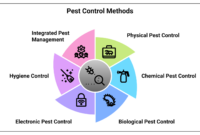
Physical Pest Control Methods
Physical control involves using barriers, traps, removal, or other methods that do not primarily depend on chemical products.
Examples include sealing cracks, installing screens, using traps for certain pests, removing standing water, and physically removing contaminated materials.
Physical control can be especially useful as part of a long-term strategy because it addresses access and environmental conditions. For example, sealing an opening where insects repeatedly enter may be more effective over time than repeatedly spraying the same area.
Biological Control
Biological control involves using natural organisms or biological processes to reduce pest populations. This method is more commonly discussed in agriculture, but the general principle is relevant to pest management more broadly.
In residential environments, biological control is less commonly used directly by homeowners because it can require specific knowledge and conditions. However, understanding natural pest relationships can help explain why indiscriminately eliminating every insect is not always appropriate.
Some insects are beneficial because they prey on other pests or contribute to ecological processes. Therefore, pest control should focus on managing problematic species rather than eliminating all organisms indiscriminately.
Chemical Pest Control
Chemical control uses pesticides or other substances designed to reduce pest populations. These products can be effective when used correctly, particularly when other methods are insufficient.
However, chemical treatment should not automatically be considered the first solution. Using a pesticide without identifying the pest or understanding the source may result in poor control and unnecessary exposure.
Products should always be used according to their labels and intended applications. More chemical does not automatically mean better pest control. Incorrect application can increase risks without improving the outcome.
Integrated Pest Management
One of the more systematic approaches to pest control is integrated pest management, commonly referred to as IPM. This approach combines different control methods rather than relying on a single treatment.
The basic idea is to monitor pest activity, identify the pest, understand environmental conditions, apply preventive measures, and use targeted treatment when necessary.
This approach is practical because it recognizes that pest problems are usually influenced by multiple factors. If food and shelter remain available, removing visible pests may not provide a lasting solution.
Monitoring After Treatment
Pest control does not necessarily end when treatment has been applied. Monitoring is important because it provides information about whether the intervention has been effective.
Homeowners can observe whether sightings become less frequent, whether new signs appear, and whether the original environmental conditions have been corrected.
If pest activity continues, the control strategy may need to be reassessed. Repeatedly applying the same treatment without evaluating the results is inefficient and can increase unnecessary costs.
When Professional Pest Control Is Necessary
Some pest problems can be handled through basic household maintenance, while others require professional assistance. Professional services may be appropriate when the infestation is widespread, persistent, difficult to identify, or associated with structural damage.
Termites are a good example because their activity can remain hidden and may affect building materials. Bed bugs can also be difficult to control because they hide in multiple locations and can spread through belongings.
Professional inspection can help determine the extent of the problem and identify an appropriate treatment strategy.
Conclusion
Effective pest control is a process rather than a single action. It begins with identifying the pest and understanding why it is present. From there, homeowners can address food sources, moisture, shelter, and structural access points that support pest activity.
Physical barriers, environmental management, and monitoring should form important parts of the strategy. Chemical treatment can be useful when necessary, but it should be applied carefully and according to the product instructions.
The most important principle is to address the cause rather than repeatedly treating the visible symptom. A home that provides fewer opportunities for pests to obtain food, water, shelter, and access will generally be easier to protect.

Dianna Bearden is a homeowner and DIY enthusiast who loves tackling household pests. She shares budget-friendly tips and proven tricks to reclaim your space from bugs.