Bacteria are microscopic organisms that can be found in many environments, including inside and around residential buildings. Their presence in a home is not necessarily a sign that the house is dirty because bacteria naturally exist on surfaces, in soil, water, food, and on human skin. However, certain types of bacteria can become a concern when they are transferred to food, frequently touched surfaces, or areas where they can multiply under suitable conditions. Understanding how bacteria spread around the home can therefore help residents develop better cleaning and hygiene habits without relying on excessive or unnecessary disinfection.

The way bacteria move from one place to another is often connected to everyday activities. People touch doors, phones, kitchen equipment, tables, bathroom fixtures, and many other objects throughout the day. When bacteria are present on hands or contaminated surfaces, they can potentially be transferred to other locations. This means that household hygiene is not only about cleaning visible dirt. It also involves reducing opportunities for microorganisms to move between people, food, surfaces, and household objects.
Where Can Bacteria Be Found?
Bacteria can exist on almost any surface, although their ability to survive and multiply depends on the environmental conditions. Dry and exposed surfaces may not provide the same conditions as moist areas containing nutrients.
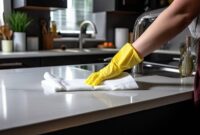
Kitchens and bathrooms are particularly important because they contain many surfaces that can become wet or contaminated. Sinks, faucets, cutting boards, countertops, sponges, towels, and refrigerator handles are examples of objects that are frequently touched or exposed to food and moisture.
This does not mean that every surface in these areas is dangerous. Rather, these locations deserve regular attention because they can provide opportunities for bacteria to remain or be transferred.
How Do Bacteria Spread?
Bacteria can spread through direct contact and indirect contact. Direct contact occurs when microorganisms are transferred from one person or object directly to another. Indirect transfer can occur when a contaminated surface is touched and the bacteria are then carried to another location.
Hands play an important role in this process. A person may touch raw food, a garbage container, a pet, or another potentially contaminated object and then touch a door handle or kitchen utensil without washing their hands first.
The process can happen quickly and without the person noticing it. This is why hand hygiene is one of the simplest measures for reducing the movement of bacteria around a household.
The Role of Hands
Hands come into contact with a large number of objects every day. As a result, they can become an important pathway for transferring microorganisms between different surfaces.
For example, someone preparing food may touch packaging, raw ingredients, cabinet handles, and kitchen equipment during the same activity. If hands are not cleaned appropriately between tasks, bacteria from one source can potentially be transferred to another surface.
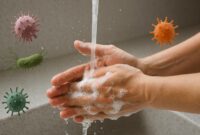
Regular handwashing is therefore an important part of household hygiene. It is especially relevant before preparing food, before eating, after using the bathroom, after handling waste, and after contact with potentially contaminated materials.
Kitchen Surfaces
The kitchen is one of the most important areas to consider when discussing bacteria in the home. Food preparation creates opportunities for microorganisms to move between ingredients, utensils, hands, and surfaces.
Raw meat, poultry, seafood, eggs, and unwashed produce can carry microorganisms. If the same cutting board or knife is used for different foods without appropriate cleaning, microorganisms may be transferred between them.
This is why separating food preparation activities and cleaning utensils properly are important practices. Kitchen surfaces should also be kept reasonably clean and dry between uses.
The objective is not to create a completely sterile kitchen. Such a condition is unrealistic in an ordinary household. Instead, the goal is to reduce contamination opportunities and maintain appropriate food hygiene.
Sponges and Cleaning Cloths
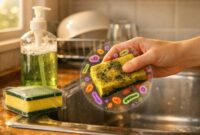
Cleaning tools can become overlooked sources of contamination. Sponges and cloths are repeatedly exposed to food particles, moisture, and microorganisms.
When a sponge remains wet for long periods, it can provide a suitable environment for some microorganisms to survive or multiply. Using the same sponge for multiple areas can also contribute to cross-contamination.
For this reason, cleaning materials should be maintained properly and replaced when necessary. Different cloths can also be assigned to different areas, particularly when cleaning kitchens and bathrooms.
The effectiveness of cleaning depends not only on the cleaning product but also on the condition of the tools being used.
Bathroom Surfaces
Bathrooms contain several surfaces that are frequently exposed to moisture. Faucets, toilet handles, sinks, shower surfaces, and door handles are regularly touched and should therefore be included in normal cleaning routines.
Moisture does not automatically mean that harmful bacteria are present. However, damp conditions can support the survival of certain microorganisms, particularly when organic material is also available.
Regular cleaning and proper ventilation can help maintain a healthier bathroom environment. Surfaces that remain wet for long periods should be dried when practical, and leaks should be repaired rather than ignored.
Food Storage and Refrigeration
Food storage is another important factor in controlling bacterial growth. Certain bacteria can multiply when food is kept under inappropriate temperature conditions for too long.
Refrigerators help slow the growth of many microorganisms, but they do not make food completely free from bacteria. Food should therefore be stored properly, and the refrigerator should be cleaned regularly.
Raw foods should also be separated from ready-to-eat foods when possible. Containers should be closed appropriately, and spills should be cleaned rather than allowed to remain inside the refrigerator.
These simple practices can reduce opportunities for microorganisms to spread between different food items.
Garbage and Waste
Household waste can contain food residues and other organic materials that support microorganisms. Garbage containers should therefore be emptied regularly, particularly when they contain food waste.
Waste bins should also be cleaned when necessary. Touching garbage and then immediately handling food or kitchen equipment without washing hands can create another pathway for contamination.
The same principle applies when handling pet waste or cleaning areas where animals eat. Hand hygiene should be part of these activities.
Pets and Bacteria
Pets are a normal part of many households and should not be viewed as a source of unavoidable danger. However, animals can carry microorganisms on their fur, paws, food bowls, and other items.
Pet feeding areas should be cleaned regularly, and food bowls should be maintained according to the animal’s needs. People should also wash their hands after handling animal waste.
These measures do not require eliminating contact with pets. They simply reduce unnecessary transfer of microorganisms between animals, surfaces, and people.
Frequently Touched Surfaces
Some household objects are touched by many people throughout the day. Door handles, light switches, remote controls, phones, keyboards, cabinet handles, and faucets are examples.
These surfaces may receive more attention during periods when someone in the household is sick. Regular cleaning can help reduce the accumulation of dirt and microorganisms.
However, it is important to distinguish cleaning from disinfection. Cleaning generally involves removing dirt and some microorganisms from a surface, while disinfection is intended to reduce microorganisms using an appropriate disinfecting product.
Not every surface needs to be disinfected continuously. Routine cleaning combined with good hand hygiene is often a more practical approach for ordinary household maintenance.
Why Moisture Control Matters
Moisture is an important environmental factor because many microorganisms survive more easily under suitable moist conditions than on dry surfaces.
Leaks under sinks, damp towels, wet sponges, condensation, and poorly ventilated bathrooms can all contribute to persistent moisture.
Addressing these conditions can therefore support better household hygiene. Repairing leaks and improving ventilation may provide longer-term benefits than repeatedly cleaning the same damp surface.
This principle is similar to other household maintenance problems: addressing the underlying condition is usually more effective than repeatedly treating the visible result.
The Importance of Regular Cleaning
Regular cleaning helps remove dirt, food residues, and other materials that can support microorganisms. A cleaning schedule does not need to be complicated.
Frequently used areas such as kitchens and bathrooms may require more frequent attention than low-contact areas. High-touch surfaces can also be cleaned according to how often they are used and the circumstances of the household.
The main objective is consistency. Cleaning once after a long period of neglect is less effective as a general strategy than maintaining reasonable hygiene practices over time.
Avoid Excessive Use of Disinfectants
It may be tempting to assume that using more disinfectant products will always create a cleaner home. However, excessive or inappropriate use is not necessarily better.
Disinfectants should be used according to their instructions, including the recommended concentration and contact time. Mixing cleaning chemicals can also create serious safety risks.
For routine household cleaning, the appropriate method depends on the surface and the level of contamination. Using the right product correctly is more important than simply using a large amount.
Handwashing as a Simple Preventive Measure
Among the different methods of reducing bacterial transmission, handwashing remains one of the most practical. It requires no specialized equipment and can be incorporated into normal daily routines.
Hands should be washed thoroughly after activities that may involve contamination and before activities involving food. The process should be consistent rather than limited to situations where visible dirt is present.
This is particularly important because bacteria and other microorganisms are not always visible. A person’s hands may look clean while still carrying microorganisms from previously touched surfaces.
What to Do When Someone Is Sick
When someone in the household is experiencing an infectious illness, hygiene practices may need additional attention. Frequently touched surfaces can be cleaned more regularly, and personal items should not be unnecessarily shared.
Hand hygiene becomes particularly important during this period. Shared bathroom and kitchen areas should also be maintained appropriately.
The exact precautions depend on the illness involved, so general household hygiene should be supplemented by appropriate health guidance when necessary.
Creating a Practical Household Hygiene Routine
A practical hygiene routine does not need to involve cleaning every surface every day. Instead, household members can prioritize areas that have a higher likelihood of contamination.
Kitchen preparation surfaces, bathroom fixtures, frequently touched objects, food storage areas, and waste containers are reasonable places to focus attention.
The routine should also include handwashing, proper food handling, moisture control, and regular cleaning of household equipment.
This approach is more sustainable because it focuses effort on the activities and locations that actually matter rather than attempting to create a completely sterile environment.
Conclusion
Bacteria are a normal part of the environment and cannot realistically be eliminated from a home. The more practical objective is to reduce unnecessary exposure and limit the conditions that allow microorganisms to spread or multiply.
Hands, kitchen surfaces, cleaning tools, bathrooms, food storage areas, garbage, and frequently touched objects can all contribute to bacterial transfer when they are not managed appropriately. Regular cleaning, proper food handling, handwashing, moisture control, and appropriate use of disinfectants can help reduce these risks.
The most important point is that household hygiene should be based on consistent and reasonable practices rather than excessive cleaning. A home does not need to be completely sterile to be well maintained. What matters is understanding where contamination is more likely to occur and applying appropriate preventive measures.
By developing simple habits and paying attention to high-risk areas, homeowners can create a cleaner and more manageable living environment. This approach is generally more practical than relying on repeated heavy disinfection or attempting to eliminate every microorganism from the home.

Dianna Bearden is a homeowner and DIY enthusiast who loves tackling household pests. She shares budget-friendly tips and proven tricks to reclaim your space from bugs.